


With the goal of monitoring chronic diseases, CIMNE participates in an investigation that proposes using the mobile phone as a kind of spirometer. Alberto Tena, member of CIMNE ICT group, is the principal investigator of this project at the centre. Funded by the Spanish Ministry of Science and Innovation, it is carried out in partnership with researchers of the Higher Technical School of the UdL and the Biomedical Research Institute of Lleida (IRB Lleida). It is focused on the development of an mobile application which allows measuring lung capacity to evaluate chronic diseases such as asthma, chronic obstructive pulmonary disease (COPD) or pulmonary fibrosis.
This mobile application would offer a reliable alternative outside the hospital environment, without additional hardware or external devices.
By the moment, a machine learning model has been developed to obtain a person's lung age by analyzing the properties of their breathing out. The team has implemented a mobile application and a similar website to record exhalations of 188 people, 91 men (48.4%) and 97 women (51.6%), aged between 17 and 67 years. Sampling records consist of a distance of approximately 20 centimeters between the mouth and the phone. The user then breathes deeply and exhales as strongly as possible for as long as possible, like in a traditional spirometry. For each sound sample, researchers analyzed 42 features. In this phase, the CIMNE team has collaborated on the methodology to obtain the phonatory features and time-frequency features of the study.
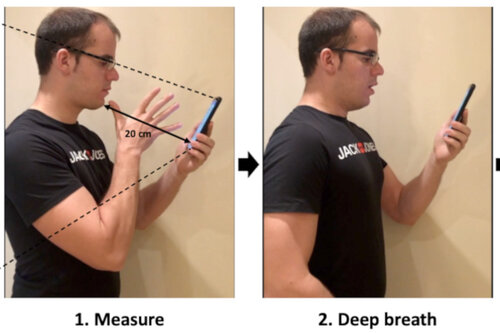
In line with this approach, they have tested different machine learning algorithms used in speech recognition. Thus they have found that using the quadratic linear discrimination algorithm and distributing people in age groups every 5 years, the accuracy of their model reaches 94.69%; sensitivity, 94.45%; and specificity, at 99.45%. «The good results obtained show that it is possible to obtain the lung age of the user by extracting the characteristics of an exhalation and that our methodology can become a reliable tool for use with mobile devices», said the doctoral student of the UdL Marc Pifarré.
«This research also opens the door to other interesting and necessary applications in health, with the diagnosis of serious tobacco use by measuring Carbon Monoxide (CO) levels in exhaled smoke», explains the IRB researcher Francesc Abella.